This course provides a thorough introduction to the principles and methods of physics for students who have good preparation in physics and mathematics. Emphasis is placed on problem solving and quantitative reasoning. This course covers Newtonian mechanics, special relativity, gravitation, thermodynamics, and waves.
Image
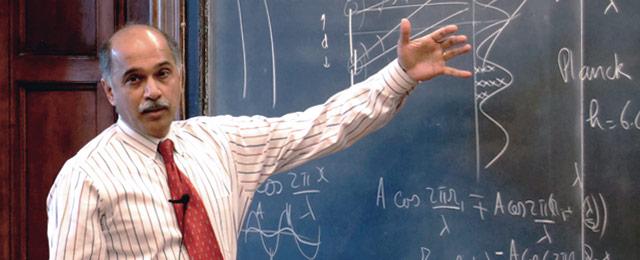
Course Number
PHYS 200
About the Course
Course Structure
This Yale College course, taught on campus twice per week for 75 minutes, was recorded for Open Yale Courses in Fall 2006. The Open Yale Courses Book Series. For more information about Professor Shankar's book based on the lectures from this course, Fundamentals of Physics: Mechanics, Relativity, and Thermodynamics http://yalepress.yale.edu/yupbooks/book.asp?isbn=9780300192209 click here.
Syllabus
Professor
Ramamurti Shankar John Randolph Huffman Professor of Physics
Description
This course provides a thorough introduction to the principles and methods of physics for students who have good preparation in physics and mathematics. Emphasis is placed on problem solving and quantitative reasoning. This course covers Newtonian mechanics, special relativity, gravitation, thermodynamics, and waves.
Texts
Wolfson, Richard and Jay Pasachoff. 1998. Physics with Modern Physics for Scientists and Engineers, 3d ed. Reading, MA: Addison Wesley Publishing Company.
Recommended: Shankar, Ramamurti. 2003. Basic Training in Mathematics: A Fitness Program for Science Students. New York: Springer Publishing Company.
Requirements:
Homework will be given every Wednesday and is due the following Wednesday before class. Solutions will be posted on Wednesdays, so problem sets must be turned in on time. There will be one in-class midterm halfway through the semester.
Grading
Homework: 20%
Midterm examination: 30%
Final examination: 50%
Letter grades will be assigned by taking the highest score of either the total final average or the final exam.