Death
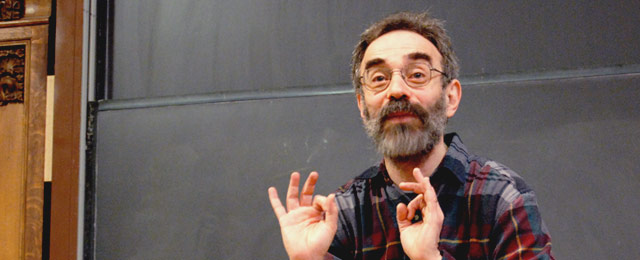
There is one thing I can be sure of: I am going to die. But what am I to make of that fact? This course will examine a number of issues that arise once we begin to reflect on our mortality. The possibility that death may not actually be the end is considered. Are we, in some sense, immortal? Would immortality be desirable? Also a clearer notion of what it is to die is examined. What does it mean to say that a person has died? What kind of fact is that? And, finally, different attitudes to death are evaluated. Is death an evil? How? Why? Is suicide morally permissible? Is it rational? How should the knowledge that I am going to die affect the way I live my life?
This Yale College course, taught on campus twice per week for 50 minutes, was recorded for Open Yale Courses in Spring 2007.
The Open Yale Courses Series
For more information about Professor Kagan’s book Death, click here.
Syllabus
There is one thing I can be sure of: I am going to die. But what am I to make of that fact? This course will examine a number of issues that arise once we begin to reflect on our mortality. The possibility that death may not actually be the end is considered. Are we, in some sense, immortal? Would immortality be desirable? Also a clearer notion of what it is to die is examined. What does it mean to say that a person has died? What kind of fact is that? And, finally, different attitudes to death are evaluated. Is death an evil? How? Why? Is suicide morally permissible? Is it rational? How should the knowledge that I am going to die affect the way I live my life?
Plato, Phaedo
John Perry, A Dialogue on Personal Identity and Immortality
Leo Tolstoy, The Death of Ivan Ilych
Course Packet:
Barnes, Julian. “The Dream.” In History of the World in 10 ½ Chapters.
Brandt, Richard. “The Morality and Rationality of Suicide.” In Moral Problems. Edited by James Rachels. New York: Harper & Row, 1979.
Edwards, Paul. “Existentialism and Death: A Survey of Some Confusions and Absurdities.” In Philosophy, Science and Method: Essays in Honor of Ernest Nagel. Edited by Sidney Morgenbesser, Patrick Suppes and Morton White. New York: St. Matrin’s Press, 1969. pp. 473-505
Feldman, Fred. “The Enigma of Death.” In Confrontations with the Reaper: A Philosophical Study of Nature and Value of Death. Oxford: Oxford University Press, 1992. pp. 56-71
Hume, David. “On Suicide.” In Essays: Moral, Political, and Literary.
Kaufmann, Walter. “Death.” In The Faith of a Heretic. New York: New American Library, 1959. pp. 353-376
Kaufmann, Walter. “Death Without Dread.” In Existentialism, Religion, and Death: Thirteen Essays. New York: New American Library, 1976. pp. 224-248
Martin, Robert. “The Identity of Animal and People.” In There are Two Errors in the the Title of This Book: A Sourcebook of Philosophical Puzzles, Problems, and Paradoxes. Peterborough, Ontario: Broadview Press, 2002. pp. 223-226
Montaigne, Michel de. “That to Philosophize is to Learn to Die.” In The Complete Essays.
Nagel, Thomas. “Death.” In Mortal Questions. New York: Cambridge University Press, 1979. pp. 1-10
Rosenberg, Jay. “Life After Death: In Search of the Question.” In Thinking Clearly About Death. Englewood Cliffs: Prentice-Hall, 1983. pp. 18-22
Schick, Theodore and Lewis Vaughn. “Near-Death Experiences.” In How to Think About Weird Things. New York: McGraw Hill, 2005. pp 307-323
Swift, Jonathan. Gulliver’s Travels, Part III, chapter 10.
Williams, Bernard. “The Makropulos Case: Reflections on the Tedium of Immortality.” In Language, Metaphysics, and Death. Edited by John Donnelly. New York: Fordham University Press, 1978. pp. 229-242
All students must attend discussion sections. Participation can help raise one’s grade, but can never hurt. However, poor attendance or non-participation will lower one’s grade.
There will be three short papers. Each should be 5 pages, double-spaced. All papers are worth equally. If papers show improvements over the term, however, the later work will be counted even more heavily.
There will be no final exam.
Discussion section attendance and participation: 25%
Three short papers: 25% each (total: 75%)
Sessions

This Open Yale Course is accompanied by a book published by Yale University Press.