The course is an introduction to Dante and his cultural milieu through a critical reading of the Divine Comedy and selected minor works (Vita nuova, Convivio, De vulgari eloquentia, Epistle to Cangrande). An analysis of Dante's autobiography, the Vita nuova, establishes the poetic and political circumstances of the Comedy's composition. Readings of Inferno, Purgatory and Paradise seek to situate Dante's work within the intellectual and social context of the late Middle Ages, with special attention paid to political, philosophical and theological concerns. Topics in the Divine Comedy explored over the course of the semester include the relationship between ethics and aesthetics; love and knowledge; and exile and history.
Image
Course Number
ITAL 310
About the Course
Course Structure
This Yale College course, taught on campus twice per week for 75 minutes, was recorded for Open Yale Courses in Fall 2008. The Open Yale Courses Series. For more information about Professor Mazzotta’s book Reading Dante, http://yalepress.yale.edu/yupbooks/book.asp?isbn=9780300191356 click here.
Syllabus
Professor
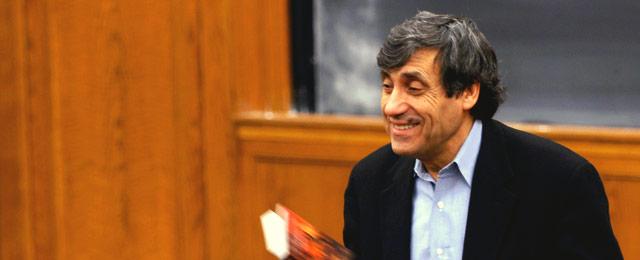
Giuseppe Mazzotta Sterling Professor Emeritus of Humanities for Italian
Description
The course is an introduction to Dante and his cultural milieu through a critical reading of the Divine Comedy and selected minor works (Vita nuova, Convivio, De vulgari eloquentia, Epistle to Cangrande). An analysis of Dante's autobiography, the Vita nuova, establishes the poetic and political circumstances of the Comedy's composition. Readings of Inferno, Purgatory and Paradise seek to situate Dante's work within the intellectual and social context of the late Middle Ages, with special attention paid to political, philosophical and theological concerns. Topics in the Divine Comedy explored over the course of the semester include the relationship between ethics and aesthetics; love and knowledge; and exile and history.
Texts
Primary Texts:
Dante. Divine Comedy. Translated by John D. Sinclair. New York: Oxford University Press, 1968.
Dante. Vita Nuova. Translated by Mark Musa. Bloomington: Indiana University Press, 1973.
Secondary Sources:
Auerbach, Erich. Dante, Poet of the Secular World. Chicago: University of Chicago Press, 1961.
Barolini, Teodolinda. Dante's Poets. Princeton: Princeton University Press, 1984.
Boyde, Patrick. Dante, Philomythes and Philosopher. New York: Cambridge University Press, 1981.
Brandeis, Irma. The Ladder of Vision. Garden City: Doubleday, 1962.
Cachey, Theodore, ed. Dante Now. Notre Dame: University of Notre Dame Press, 1995.
Davis, Charles T. Dante and the Idea of Rome. Oxford: The Clarendon Press 1957.
Freccero, John. Poetics of Conversion. Cambridge: Harvard University Press, 1986.
Gilson, Etienne. Dante the Philosopher. New York: Sheed & Ward, 1949.
Harrison, Robert. The Body of Beatrice. Baltimore: The Johns Hopkins University Press, 1988.
Mazzotta, Giuseppe. Dante, Poet of the Desert. Princeton: Princeton University Press, 1979.
Mazzotta, Giuseppe. Dante's Vision and the Circle of Knowledge. Princeton: Princeton University Press, 1993.
Moevs, Christian. The Metaphysics of Dante's Comedy. Oxford: Oxford University Press, 2005.
Singleton, Charles. An Essay on the Vita Nuova. Cambridge: Harvard University Press, 1977.
Recommended:
Saint Augustine. Confessions. Translated by Rex Warner. New York: New American Library, 1963.
Virgil. The Aeneid. Translated by Allen Mandelbaum. New York: Bantam Classics, 1981.
Requirements:
Regular attendance is required.
Students will write a final paper of approximately 3000 words to be submitted two weeks after the last class.
Students will take two tests: one in mid-term, and one at the end of the term.
During lecture, a number of possible topics for the term papers will be suggested. A list of topics will be handed out in early November. The topics should be discussed either with the professor or the teaching assistant.
Grading
Midterm examination: 15%
Final examination: 15%
Final paper: 60%
Attendance and participation: 10%
Sessions
| Lecture 1 | Introduction |
| Lecture 2 | Vita Nuova |
| Lecture 3 | Inferno I, II, III, IV |
| Lecture 4 | Inferno V, VI, VII |
| Lecture 5 | Inferno IX, X, XI |
| Lecture 6 | Inferno XII, XIII, XV, XVI |
| Lecture 7 | Inferno XIX, XXI, XXV, XXVI |
| Lecture 8 | Inferno XXVI, XXVII, XXVIII |
| Lecture 9 | Inferno XXX, XXXI, XXXII, XXXIII, XXXIV |
| Lecture 10 | Purgatory I, II |
| Lecture 11 | Purgatory V, VI, IX, X |
| Lecture 12 | Purgatory X, XI, XII, XVI, XVII |
| Lecture 13 | Purgatory XIX, XXI, XXII |
| Exam 1 | Midterm Exam |
| Lecture 14 | Purgatory XXIV, XXV, XXVI |
| Lecture 15 | Purgatory XXX, XXXI, XXXIII |
| Lecture 16 | Paradise I, II |
| Lecture 17 | Paradise IV, VI, X |
| Lecture 18 | Paradise XI, XII |
| Lecture 19 | Paradise XV, XVI, XVII |
| Lecture 20 | Paradise XVIII, XIX, XXI, XXI |
| Lecture 21 | Paradise XXIV, XXV, XXVI |
| Lecture 22 | Paradise XXVII, XXVIII, XXIX |
| Lecture 23 | Paradise XXX, XXXI, XXXII, XXXIII |
| Lecture 24 | General Review |
| Exam 2 | Final Exam |
ITAL 310

This Open Yale Course is accompanied by a book published by Yale University Press.