In "The American Novel Since 1945" students will study a wide range of works from 1945 to the present. The course traces the formal and thematic developments of the novel in this period, focusing on the relationship between writers and readers, the conditions of publishing, innovations in the novel's form, fiction's engagement with history, and the changing place of literature in American culture. The reading list includes works by Richard Wright, Flannery O'Connor, Vladimir Nabokov, Jack Kerouac, J. D. Salinger, Thomas Pynchon, John Barth, Maxine Hong Kingston, Toni Morrison, Marilynne Robinson, Cormac McCarthy, Philip Roth and Edward P. Jones. The course concludes with a contemporary novel chosen by the students in the class.
Image
Course Number
ENGL 291
About the Course
Course Structure
This Yale College course, taught on campus twice per week for 50 minutes, was recorded for Open Yale Courses in Spring 2008.
Syllabus
Professor
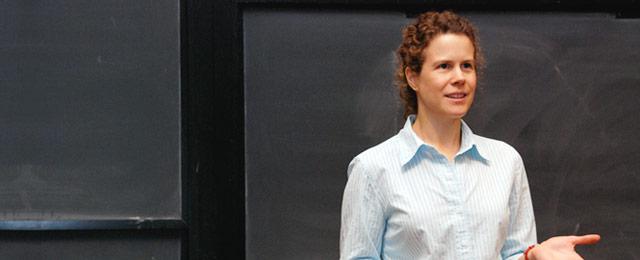
Amy Hungerford Professor of English
Description
In "The American Novel Since 1945" students will study a wide range of works from 1945 to the present. The course traces the formal and thematic developments of the novel in this period, focusing on the relationship between writers and readers, the conditions of publishing, innovations in the novel's form, fiction's engagement with history, and the changing place of literature in American culture. The reading list includes works by Richard Wright, Flannery O'Connor, Vladimir Nabokov, Jack Kerouac, J. D. Salinger, Thomas Pynchon, John Barth, Maxine Hong Kingston, Toni Morrison, Marilynne Robinson, Cormac McCarthy, Philip Roth and Edward P. Jones. The course concludes with a contemporary novel chosen by the students in the class.
Texts
Richard Wright, Black Boy (American Hunger) (Harper Perennial Restored edition, 1993) 1945
Flannery O'Connor, Wise Blood (Farrar, Straus and Giroux) 1949
Vladimir Nabokov, Lolita (Vintage) 1955
Jack Kerouac, On the Road (Penguin) 1957
J.D. Salinger, Franny and Zooey (Little, Brown) 1961
John Barth, Lost in the Funhouse (Anchor) 1963-68 (selections)
Thomas Pynchon, The Crying of Lot 49 (HarperCollins) 1967
Toni Morrison, The Bluest Eye (Knopf) 1970
Maxine Hong Kingston, The Woman Warrior (Vintage) 1976 (selections)
Marilynne Robinson, Housekeeping (Picador) 1980
Cormac McCarthy, Blood Meridian (Vintage) 1985
Philip Roth, The Human Stain (Houghton Mifflin) 2000
Edward P. Jones, The Known World (Amistad) 2003
Students' Choice Novel for Spring, 2008: Jonathan Safran Foer, Everything is Illuminated (Houghton-Mifflin) 2002
Requirements:
Students must complete the readings, explore archival material on the web for selected authors and attend all lectures.
Students must enroll in a section in order to take the course; attendance at section will not only enhance the intellectual benefit and pleasure of the course (and will fill out 5% of your grade) but will also help you in preparing the papers. Your papers and exams will be graded by your TF.
Written work will consist of:
1. Two graded papers: each a literary analysis of a single text, minimum 5 pages, maximum 8 pages.
2. Final exam: will cover the whole semester; identifications, passage readings, and one essay. The papers, lectures and section discussions, if pursued with energy and attended regularly, should prepare you well for the exam.
Grading
Paper 1: 30%
Paper 2: 30%
Final exam: 35%
Discussion section attendance and participation: 5%